


 John’s Island salutes new water supply as praise pours in for an inspired idea
STORY BY STEVEN M. THOMAS (Week of April 23, 2026)
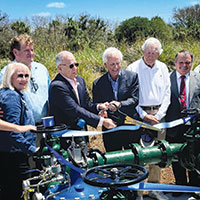
Last Wednesday was a banner day for John’s Island, especially the property owners association, which held a ribbon cutting to celebrate completion of an ingenious piece of civil engineering that will deliver 3 million gallons of fresh water daily to keep the country club community lush and green.
It was a big day for Vero Beach, too. The $13.5-million water project conceived by Water and Sewer Director Rob Bolton and designed by him and his department, satisfies the city’s lagoon nitrogen reduction requirements for the next decade at a minimal cost.
It also saves the city tens of millions of dollars and nets it a small amount of regular revenue from the sale of purified canal water to John’s Island.
Vero Beach is one of dozens of cities, counties and agencies required by the state’s Indian River Lagoon Basin Management Action Plan, or BMAP, to reduce the flow of nitrogen and phosphorous into the lagoon, where the chemicals feed harmful algae blooms.
“Building stormwater projects that would remove the 17,000 pounds of nitrogen per year this project removes would cost the city an estimated $34.2 million,” said Bolton.
“Our cost on this project is only about half a million ... and it meets our BMAP requirements through 2035.”
St. Johns River Management District and Florida Department of Environmental Protection kicked in more than $5 million because of the project’s ecological benefits, and John’s Island Property Owners Association picked up most of the rest of the tab in return for a guaranteed flow of eco-friendly irrigation water.
The project benefits the Indian River Lagoon environment in two main ways.
First, the water that will whirl from sprinklers in John’s Island is pumped out of the county’s main relief canal, which empties into the Indian River Lagoon laden with nitrogen and phosphorus, harmful chemicals that feed algae blooms.
Pulling out 20 percent of the canal’s flow, purifying it and piping it to JI, where it empties into ponds that store irrigation water, reduces the amount of pollution entering the lagoon.
Second, the new supply means John’s Island can stop drawing irrigation water from the aquifer that provides the island, mainland Vero Beach and the rest of Indian River County with part of its drinking water.
“I would say for me, the single most important thing about this project is that it means the community can stop using drinking water to irrigate lawns and golf courses,” said District 5 County Commissioner Laura Moss, who represents most of the barrier island. “It’s also important because it can become a template for other communities to do similar projects.”
Johns Island Property Owners Association President David Fisher, who conducted the ribbon cutting, picked up on Moss’s point.
“This project has received political claim as being a water conservation project that can be repeated around the state of Florida,” Fisher told the gathering, which included an impressive array of politicians, community representatives, water experts and environmentalists.
Besides Moss, District 3 County Commissioner Joe Earman, Vero Beach Mayor John Cotugno, city council members Aaron Vos, John Carroll and Taylor Dingle were in the crowd, along with representatives from Indian River Land Trust, St. Johns River Management District, John’s Island Water Management Board, John’s Island Property Owners Association Board and John’s Island Club.
The property owners association will use 2.8 million gallons of the new water for lawns and common areas, while the Club, a separate entity, will use 200,000 gallons daily to irrigate its two island golf courses.
“I want to welcome you all and tell you how delighted we are to have this moment finally come,” Fisher said, before he and Cotugno cut the blue ribbon on one of four heavy-duty valve assemblies that channel water from the main pipeline to the irrigation holding ponds.
The innovative project was a long time coming. Bolton conceived the project in the Covid-19 summer of 2020, which means a child born the day he got his bright idea would be entering first grade this fall.
It has been an even longer slog for John’s Island. Fischer said the community has struggled for almost a decade to find a better way to irrigate its 1,650 acres. Along with well water, the community had been watering the grass with reuse water supplied by Vero Beach via an old pipeline, but that processed sewer water was still high in nitrogen, making it a danger to the lagoon.
Along with Fisher, two prior association presidents spent their tenures trying to solve the Rubik’s Cube of a clean, reliable water supply.
Jim Poole, who Fisher succeeded, stood beside him during the ceremony, and Fisher had lots of praise for Lou Hoynes, who led the association before Poole but was prevented by health problems from attending the blue ribbon gathering.
He also praised the efforts and cooperation of Vero Beach leaders and spoke very highly of Bolton, who was present with several of his key staff members.
Bolton spoke briefly, explaining the timeline and travails of the project.
In summary, it will pull mildly polluted water from Vero’s main relief canal, pipe it a short distance to a redundant water plant built in the 1950s, purify the water, and then pump it via a new pipeline under the lagoon to John’s Island, where the sparkling commodity will keep golf courses and lawns looking more like Ireland instead of Arizona.
A powerful new set of pumps sucks water out of the canal across from Vero Beach Regional Airport, pushing it to the old water purification facility on the north side of Aviation Boulevard. After treatment, two even more powerful pumps send the water through a new, 6.9-mile, high-density polyethylene pipe that runs north along the railroad tracks to 41st Street, east along 41st to Indian River Boulevard, and then north along Indian River Boulevard to 45th Street.
From there it goes east along 45th to Gifford Dock Park on the shore of the lagoon, dives down 80 feet, goes under the waterway and remerges at the Land Trust’s Bee Gum Point conservation property on the island.
From there, the thick-walled pipe, which has an 18-inch exterior diameter and 16-inch interior diameter, extends to Fred Tuerk Drive, goes west along that road to Highway A1A and north along A1A to John’s Island.
The city and JI are still working out bugs in system, which has been operating for several months now. The goal is a self-regulating system run almost entirely by software and AI that will monitor and adjust water flow based on environmental conditions with no need for anyone to turn a wrench or click a switch. “This project is a great example of a public/private partnership and shows what can be accomplished through intergovernmental cooperation,” Cotugno said.