


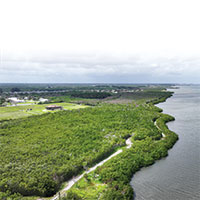
 Uncertain title derails county environmental land purchase
STORY BY JON PINE (Week of April 30, 2026)
The county’s attempt to purchase a prime piece of riverfront property for its conservation land portfolio has fallen through after three separate companies refused to provide title insurance for the property.
The 36-acre tract on the western shore of the lagoon near Wabasso would have been the fifth property scooped up by the Environmental Lands Acquisition Program (ELAP), which was overwhelmingly approved by voters in November 2022.
The county wanted this tract because of its proximity to the Indian River Lagoon and other conservation land and entered into a contingent contract to purchase the property for $1.57 million. But the owner was unable to rectify two gaps in the property’s chain of title, Assistant County Attorney Chris Hicks told county commissioners at their April 7 meeting.
The owner may be able to fix the gaps through a “quiet title action” – a legal process to establish clear ownership of the property – but that could take six months or longer, according to Hicks, who noted that the county’s deadline for performing due diligence on the purchase would expire before then.
If the county had gone ahead and purchased the property despite the faulty paperwork, under Florida law it would not be able to obtain a clear title for seven years, Hicks told commissioners.
After hearing what Hicks had to say, commissioners voted to cancel the contract for now, with the option of bringing it up again if and when the owner gets clear title and providing that program funds are still available.
Now vacant, but once partially a citrus grove in the 1940s and 1950s, the property is made up of two parcels east of U.S. 1 between 73rd Street on the north and 69th Street on the south. Both parcels are owned by The William M. Luther Irrevocable Trust.
About 25 acres of the property is zoned for single-family residential use with a maximum of three units per acre. The rest is zoned residential with a maximum of one unit per acre. In total, approximately 85 houses could be built on the land.
Every acre of development along the shore of the lagoon adds to the difficulty of restoring the waterway’s natural ecology, as new construction tends to bring stormwater runoff and nitrogen that harms the lagoon environment. The county’s acquisition would have protected the property from development forever.
About 55 percent of the land, the eastern portion closest to the lagoon, is identified as mangrove swamp and saltmarsh wetlands, while the rest is a mix of hardwood uplands and pine flats. The site is also home to many animal species, some endangered or threatened, including wood storks, yellow- and black-crowned night-herons, gopher tortoises, eastern indigo snakes, and several fish species.
Visitors have also seen otters, osprey, owls and bobcats on the property, according to an assessment by Water & Air Research, an environmental consulting firm based in Gainesville, Florida that helped the county evaluate the property.
The site is ideal for a recreational site for canoeing, fishing, hiking and wildlife viewing with educational kiosks, the study says.
The City of Vero Beach owns and maintains a canoe/kayak launch at the end of 69th Street just south of the site, according to the study.
The area also possesses historic interest.
From 1923 into the 1940s, a wooden bridge crossed the lagoon from 69th Street to Hole in the Wall Island, which was popular with boaters and fisherman, and continued on to Jungle Trail on the barrier island. The bridge was used to transport farm produce harvested on Orchid Island to the mainland. Today, Hole in the Wall Island is owned and managed by the Indian River Mosquito Control District.
Mosquito impoundments were constructed on the site in the 1950s and also on a 19-acre lagoon front parcel that adjoins the property to the south, which is managed by the St. Johns River Water Management District. The district and the county have an agreement to work together on coastal restoration projects and could stitch the two sites together with a walking trail, if the county purchase eventually takes place, according to Wendy Swindell, the county’s assistant director of conservation lands.
Both sites are ideal for projects that would improve water flow between the mosquito impoundments and the lagoon, which would help to purify stormwater that empties into the waterway, Swindell said.
The county is actively looking for additional environmentally significant property. Parcels can be nominated for purchase by county staff, environmental groups, individual landowners and members of the public.
A nine-person panel of volunteers with backgrounds in natural resources, planning and engineering, real estate and finance, plus representatives from all five county districts, evaluate and rank nominated properties.
So far, the county, which only enters into negotiations with willing sellers, has purchased four of the most highly ranked properties:
• 21.89 acres on U.S. 1 one mile north of Wabasso Causeway formerly owned by Hale Groves. Price: $2.54 million.
• 11.72 acres east of U.S. 1 also about one mile north of the Wabasso Causeway and adjacent to the Hale Groves site known as Durrance Place. Price: $1.26 million.
• 15.47 acres in Osprey Estates west of the Indian River Lagoon across from Gifford Point between Gifford Dock Road and Bridgeview. Price: $1.64 million.
• 19.36 acres on the island along the Indian River Lagoon that are adjacent to the Captain Forster Hammock Preserve Indian River Conservation area. Price: $5.9 million.
The first ELAP bond was issued in June 2024 for $25 million, which must be spent by June 2027. Once that money has been used, the county will issue a second $25 million bond and continue the process of preserving valuable parts of the natural world for future generations.
The $50-million program approved in 2022 is the third conservation land bond issue passed in Indian River County in the past 32 years. Voters approved $26 million in bonds in 1992 and another $50 million in 2004. That $76 million resulted in the acquisition of 38 sites partially or wholly owned or managed by the county. The sites encompass more than 12,000 acres and protect 17 distinct natural habitats.
The $76 million from the first two environmental bonds attracted an additional $62 million from FDEP, Florida Fish and Wildlife, Florida Inland Navigation District and other agencies that allowed the county to buy up $138 million worth of conservation land. If that ratio holds for the current bond funding, citizens could gain another $90 million in preserve property.
Anyone who would like to nominate an environmentally significant property for preservation or learn more details about nominated or purchased parcels can go to: indian-river-county-elap-ircgis.hub.arcgis.com.