


 Coastal Connections helps rescue hundreds of sea turtles annually
STORY BY SAMANTHA ROHLFING BAITA (Week of August 13, 2026)
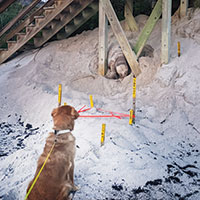
Photo: Golden retriever Ginny found a trapped sea turtle under the beach access stairs near Turtle Trail in Indian River Shores.
Annie Astley and her golden retriever Ginny were enjoying an early morning walk one day this summer, strolling along the sand near Turtle Trail beach access in Indian River Shores.
The moon was full and the air still, when suddenly Ginny began barking, pulled on her leash and ran toward the beach access stairs at the dune line. Astley called Ginny back, but the dog didn't move, just stood in the sand at the bottom of stairs and kept barking. It was a few minutes after 6 a.m. according to Astley's phone, just before dawn.
With the moonlight illuminating the sandy space below the stair platform, Astley was finally able to see the cause of Ginny's behavior – a giant sea turtle was trapped between the wooden support beams. Struggling to free herself, the turtle had become almost entirely embedded in the sand.
"She didn't seem injured," Astley recalls. "She was moving her flipper. She just looked tired."
Indian River County is in the midst of a record-breaking sea turtle nesting season. As of Aug. 7, with three months left before the end of the season, county trackers had already counted nearly 10,000 loggerhead sea turtle nests, the most ever in a single season.
Altogether, counting green turtles and leatherbacks along with loggerheads, more than 12,000 of the massive and mysterious creatures have made nests between the Sebastian and Fort Pierce Inlets since early March.
Most lumber up the beach, lay their eggs and return to the ocean without difficulty as nature intends, just as they have been doing for millions of years.
But with that many turtles coming ashore at night, often along developed stretches of beach, mishaps occur and hundreds of them need to be rescued each year, according to Kendra Bergman, executive director of Vero Beach sea turtle advocacy nonprofit Coastal Connections.
"The numbers vary depending on weather and storms, but there are about 300 rescues a year in Indian River County, with about 100 of those transported to Brevard Zoo, Sea World or another turtle care organization for treatment," Bergman says.
With a permit from Florida Fish and Wildlife, Coastal Connections operates the largest sea turtle rescue response team in the county, documenting and assisting sick, injured and exhausted sea turtles, according to its website.
Astley knew about Coastal Connections and her first action after realizing the big turtle's plight was a phone call to the organization. After determining that the animal was just stuck, not injured, Coastal Connection personnel called the Disney resort in Wabasso, seeking the assistance of the trained "turtle rescue" crew stationed there, who had ATV's and could help extricate the trapped turtle.
The first rescue crew member arrived at 6:40 a.m., just as the sun was rising.
"Wow! That turtle is massive," the woman said, and immediately called her colleagues for additional help.
Two more crew members pulled up around 7 a.m. and started digging.
With the combined efforts of the Disney-stationed crew, Astley and a couple other morning beach walkers, all on their hands and knees scooping sand, the loggerhead turtle was finally freed from the sand and timbers.
Able to move again, she made her way back down the beach and into the ocean around 7:10 am.
Nesting sea turtles are big animals, ranging from 150 pounds for the smallest green turtles up to 2,000 pounds for the largest leatherbacks, but they start out very small.
Hatchlings are only an inch or two long and often weigh less than an ounce. They are programed to head straight for the surf when they hatch but sometimes get confused or stuck and need to be rescued, just like their mothers.
The event is common enough that Coastal Connections has drop boxes stationed strategically around the island where injured or exhausted hatchlings can be placed while waiting for release by a qualified expert or transport to a care facility.
One of those drop boxes came in handy one night a couple of weeks ago when Angela Waldrop was walking on the beach below the Riomar Country Club golf course with relatives visiting from Tampa.
Shortly before 10 p.m. they came across a nest where turtles were hatching and scurrying toward the waves.
"We noticed one little one had a left flipper that seemed small or injured," says Waldrop, who manages the rental division at Dale Sorensen Real Estate and is the proprietor of @vacationvero on Instagram, which focuses on the beauty of the Vero Beach's coastal environment.
Waldrop called her colleague Elizabeth Sorensen, who is involved with Coastal Connections, and Sorensen called Bergman who told the duo what to do with the hatchling – who they had named Nemo after the Pixar clownfish that also had an undersized fin.
"We were instructed to gently place Nemo in a container and transport him to the nearest hatchling drop box," Waldrop says.
"There are four of these permitted drop boxes across the island for rescues like Nemo's. We were told it was extremely important not to put Nemo in water in the box because it would trigger the turtle to swim when it actually needed to rest. We were also told to follow all the instructions posted at the drop box."
"The drop boxes are for hatchlings and wash-backs, small turtles, no larger than your hand," says Bergman.
Wash-backs are hatchlings that made it to the ocean and lived in the water for a while, usually hiding and feeding in mats of sargassum seaweed, but then were pushed back ashore by storm driven waves.
They often are exhausted when they are found and would die if placed back in the water without rest or treatment.
"The drop boxes serve as safe locations for injured hatchlings and wash-backs, helping rescue and care for an average of 30-plus small sea turtles each year," says Waldrop. "Each turtle left in a drop box is documented and evaluated by a Coastal Connections rescue team member. Many are released after resting and regaining energy but, a number of them are transported up to the Brevard Zoo's sea turtle healing center to get important medical care."
At the drop box, Angela texted the provided number, informing the Coastal Connections rescue coordinator of the turtle's condition and where it was found.
"They did everything right," says Bergman, who does not publicize the location of the drop boxes because she doesn't want curious people stopping by to check and see if there are turtles in the coolers or otherwise interfering with the time-sensitive rescue process.
It is illegal in Florida to touch, pick up or interfere in any way with sea turtles or their nests without a permit, which is why permitted organizations like Coastal Connection are crucial, keeping turtle rescue and care in the hands of experts.
"We try to get the word out to everyone that they should call Florida Fish and Wildlife if they see a sea turtle that is in trouble," says Bergman. "They are the clearinghouse and will coordinate with us if an on-scene response is needed here in Indian River County.
"Our permit covers the entire shoreline of the county, from the Fort Pierce Inlet to the Sebastian Inlet."
Similar permitted organizations exist in Brevard and St. Lucie counties to help turtles in those areas.
Besides documenting and responding to sick and injured turtles, Coastal Connections has a broader mission focused on "advancing sea turtle survival by educating and connecting people to the environment."
Founded by Bergman in 2017, the group offers daytime and nighttime guided turtle walks, organizes beach cleanups and provides programing for local schools.
With five staff members and 180 volunteers, it has helped educate more than 3,400 students about sea turtles and the environment, cleared nearly 40,000 pounds of trash and debris from local beaches, taken hundreds of wide-eyed participants on turtle walks – and helped rescue a large and ever-growing number of green, leatherback and loggerhead sea turtles.
Nemo was one of those.
"After resting and regaining energy, Nemo was released the following morning at sunrise by the Coastal Connections nest survey team," says Waldrop.
"Finding Nemo is not a rescue story that any of us involved will ever forget!"
Coastal Connections aims to "create a community where sea turtles and humans thrive, through one connection at a time," and that is just what happened for two turtles and two nature lovers here in Vero Beach this summer.
The Florida Fish and Wildlife number to call if you find a sick, injured or exhausted sea turtle is 888-404-3922. Coastal Connections number is 772-226-0133. You can find out more about the sea turtles and the group's activities at https://coastal-connections.org.