


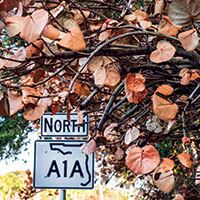
 Plants bear brunt of worst cold spell felt here in decades
STORY BY JON PINE (Week of February 26, 2025)
February marched in like a lion in Vero Beach, with three consecutive nights of record-breaking subfreezing temperatures not seen here in decades. Described by meteorologists as an “historic cold weather outbreak,” the extended chill left homeowners across the city, and the city itself, with droopy, brown trees, hedges and other plants.
The mercury dipped down to 26 degrees here on Feb. 1, breaking the previous record low of 29 degrees for that date, set in 1966. If that wasn’t enough, temperatures plunged to 27 degrees the next night, breaking another record low set in 1980 – by 7 degrees.
On Feb. 3, the mercury dropped below freezing again, this time to 31 degrees, one degree lower than the previous record of 32 degrees set in 1976.
This wasn’t a cold snap – which is a sharp, steep drop in temperature that comes and goes quickly, said Nicky Munroe, an environmental horticulture agent and Master Gardener Coordinator for Indian River County.
“This was a prolonged freeze,” Munroe said. “There is a difference in the way plants react to each of these circumstances. Most plants will survive a cold snap. But a lot of plant material will not survive a freeze.”
Leaves and other plant tissue are full of water, and when that water freezes it destroys internal plant structures and sometimes kills the plants.
The last prolonged freeze most Floridians will remember was in 1989, when an intense arctic influx brought subfreezing temperatures to the state, even as far south as Miami, from Dec. 22 to Dec. 24. All 67 counties were declared disaster areas as pipes burst, icy roads were shut down and many areas experienced rolling power outages.
Some places in northern Florida saw their first white Christmas, as snow drifted down to cover tropical plants, and the freeze caused more than $1 billion in damages to the citrus industry and other agricultural industries. That freeze contributed to the eventual decline of the Florida citrus industry as some growers gave up and sold devastated groves to real estate developers.
Nanette Haynes has managed the maintenance of Vero Beach’s 12 large public parks and other smaller neighborhood parks for 24 years. She was not working for the city in 1989, but she’s heard stories of the city losing hundreds of royal palm trees in that freeze.
She does remember when the city installed the playground at Humiston Park and upgraded the park’s landscaping. “That was in October of 2014, and there was a freeze the following month,” Haynes said. The plants hadn’t been in the ground long enough to develop a robust root structure, and they all died and had to be replaced.
For now, her landscape crews are waiting - probably until after March - to start clearing dead plants and trees, Haynes said. Although homeowners may be tempted to prune or dig up their seemingly dead trees and plants, they should resist that temptation, according to Haynes and Munroe. “Mostly, what you should do is watch and wait,” Munroe said.
The reason? For starters, there are still six to eight weeks of winter left and there could be another freeze, Munroe said. Also, just because a plant looks dead, it may not actually be dead. Replacing them now is unwise, because they won’t have time to develop strong roots in time, should the area get another cold spell. “If the leaves are brown and papery, leave them alone. They will act as natural insulation for the plant,” Munroe said. “If the plant tissue is wet or slimy, take it off immediately. That material is actively breaking down and leaving it will increase the risk of disease and rot.”
Now is not the time to fertilize or give plants a lot of water, either, Munroe said.
If anything, homeowners should consider adding another layer of mulch at the roots of plants. “This will help to hold the rest of the plants’ systems together,” Munroe said.
For homeowners and HOA determined to pretty up yards immediately, an alternative to replanting is to get some container plants, Munroe said. “It’s easier to cover them when they are in containers. You can put them inside or in a tent in the yard if another cold spell is predicted.” And when the weather warms up, they can be planted in the ground, she added.
When it does come time to prune or replace your trees and plants, try bending a small branch, said Carla Flournoy, secretary for the Eugenia Chapter of the Florida Native Plant Society. “If it bends, it’s still alive, no matter what color it is. If it snaps easily, it’s dead and time to prune.”