


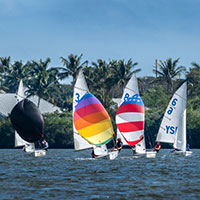
 Youth Sailing center groundbreaking was splash hit!
STORY BY JON PINE (Week of January 15, 2025)
A dream that began more than a decade ago came to fruition on Friday when a crowd gathered to cheer on the Youth Sailing Foundation as it broke ground on its $5.6-million Community Sailing Center on the west shore of the Indian River Lagoon south of the Alma Lee Loy Bridge.
The occasion also marked the beginning of construction of the long-awaited and often-debated Three Corners development project, which will include a luxury hotel, docks, waterfront dining, retail shops and recreational opportunities on city-owned land north of the bridge.
“This is the first shovel in the ground for the Three Corners project,” said Stu Keiller, Youth Sailing Foundation board member and manager of the sailing center project. About 160 people turned out for the ground-breaking, including Charlie and Chris Pope, who founded YSF in 2009.
The 3-acre Marine Recreational Park that surrounds the sailing center site is named after the Popes. Youth Sailing signed a long-term lease for the city-owned property in 2023.
Also on hand for the groundbreaking were Julia Harris, the widow of Pat Harris, who served as chairman of the foundation from 2015 until just before he passed away in 2023, and the Harrises’ daughters, Emily Harris, Erica Nardone and Mimi Stedman. A donor who contributed $1 million toward the $5 million cost of the sailing center chose to name the building after Pat Harris, Keiller said.
Youth Sailing has collected enough money to pay for the 10,000-square-foot sailing center building, which is Phase 1 of the project, and recently launched a $1 million capital campaign for Phase 2, which includes $600,000 to complete the park, pier, pavilions, floating docks and other amenities. The remaining $400,000 will go into a reserve fund to cover the costs of future repairs or renovations, Keiller said.
More than enough money already has been raised to finish the park, so construction for Phases 1 and 2 will occur simultaneously, Keillor said. Construction of the sailing center, built by Proctor Construction, is slated for completion in December, he said.
Site work actually began a month before the groundbreaking celebration, when contractors demolished a giant concrete tank that was part of the city’s wastewater system until a few days before it was knocked down. Demolition began Dec. 1 and wrapped up on Dec. 16.
The city’s wastewater plant is adjacent to the sailing center site, but it will be decommissioned and torn down within a few years, after a new “One Water” facility opens by the airport.
Some of the concrete rubble from the tank was used to shore up the riprap along the 3-acre park’s 570-foot waterfront, Keiller said.
The two-story, 10,000-square-foot tropical colonial sailing center will be built on a forest of pilings that go down 20 or 25 feet to hard substrate, supporting a heavy concrete slab foundation.
“This is all fill land,” Keiller said. “The pilings go down through the mud layer to coquina.”
The first floor will be reinforced concrete block; the second will be hollow, dense foam blocks laced with rebar and filled with concrete to make a wall structure that is both stronger and lighter than traditional block. This material will provide the added benefit of thermal and acoustic insulation.
“The second floor is the part that will be air conditioned, so the insulation is important,” says Keiller. “It will also dampen traffic noise from the bridge.”
The main second-floor room will have wood-lined vaulted ceiling “that vastly changes the nature of the room – the acoustics and the lighting – for a more dramatic appearance,” Keillor said. The room will hold up to 120 people. Rolling room dividers will create three classrooms with state-of-the-art television monitors and teaching aids.
There will also be an 11-foot-deep veranda along the front of the building facing the Indian River Lagoon that will widen at the south end into a 900-square-foot terrace with sweeping views to the east and south.
“We have surveyed many sailing centers in Florida and the Northeast, and they all say the most-used part of their centers are outdoor spaces, especially if they are elevated and have views,” says Keiller. The veranda and terrace will be equipped with high-end teak furniture selected by a local interior designer who supports the sailing organization.
The finish roofing will be standing seam aluminum, which resists corrosion better than a typical steel standing seam roof.
The building’s first floor will include expansive, well-equipped boat repair shops, boat storage space, onshore instructional space, a large office for the sailing program and restrooms with showers.
Impressive as the new building appears on paper, Keiller says the project is not mainly about the building.
“It is the programs we will operate out of it that are the heart of what we are doing,” he says.
Those programs include a wide array of classes for children, teens and adults, including classes for disabled sailors.
“Our purpose is to empower the youth of the county to fulfill their potential,” said current YSF board chair Bill Krueger. “That’s a very bold endeavor. We achieve it through the sport of sailing.”
From its inception, YSF has made sailing available to children who couldn’t otherwise participate in a sport that often is available only to wealthier families. About 50 percent of YSF sailors are scholarship students. Philanthropy and fees paid by adult sailors support the free training.
“Most sailing organizations have just a handful of scholarships,” said Krueger. “These are folks whose families don’t have the means to pay the fees,” let alone buy a boat.
It costs around $3,000 per child each year to provide training and maintain the 80-plus sailboats and motorboats that are available to members, he said.
“We’ve been fortunate that the community has been very, very supportive,” Krueger said.
Keiller says Youth Sailing serves about 300 unique sailors each year, up from 150 a year five years ago. During the same period, the organization’s revenue has doubled from about $450,000 to $900,000, with 85 percent of the money coming from donations.
The young sailors mirror the county’s demographic, with solid contingents from 32963, Gifford and other areas. Sailors come from about 35 schools, including many church schools. Students at Vero Beach High School who participate can letter in sailing.
There’s also a program dedicated to special needs children who are provided with custom-designed boats from Australia and accompanied by volunteers. This program typically serves around 30 children each term.
The children compete in three levels of regattas, from what Keiller calls “minor league” regattas held by half a dozen clubs between West Palm and Melbourne, up to the U.S. Sailing Youth Championships held in far flung waterfronts on the Great Lakes, Gulf of Mexico, and East and West Coasts of the United States.
“Our kids sometimes dominate in the local regattas, taking first place in all three youth classes,” Keiller says proudly.
Youth Sailing Foundation is a nonprofit organization. Membership for those who can afford it is $600 per year, all of which goes to pay for the programs for underserved kids. Classes cost extra. Members can reserve boats online, seven days a week.
YSF accepts cash and donations of power boats and sailboats. A team of volunteers refurbishes the boats and either adds them to the fleet or sells them to raise money for the foundation.