


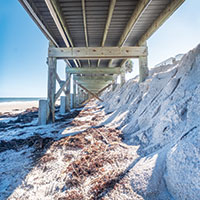
 Full extent of storm damage not yet known
STORY BY JON PINE (Week of November 12, 2026)
The City of Vero Beach was light on its feet this week, quickly making minor emergency repairs at the Conn Beach Boardwalk. The southern end of the scenic walkway, where erosion caused by king tides and high surf was worst, has been reopened to pedestrians, along with a couple of staircases.
But the bulk of the damage there and elsewhere up and down the island coast is still being evaluated prior to making plans for repairs.
"It was a very, very strange storm," said Quintin Bergman, Indian River County's coastal resource manager. "When a hurricane comes through, it's quick and the erosion is pretty evenly distributed. This was nothing like that. It lasted for over a week, and it was slowly taking bites out of the dune. Erosion did not occur evenly."
Beaches at the north end of the barrier island were barely impacted, Bergman said, but as you move south toward Wabasso, the erosion starts to get worse. The reason, he said, is because erosion is always worse downdrift from where properties have erected seawalls – which is the case north of Wabasso Beach Park.
"In areas where we have a lot of coastal armoring, we're going to have higher rates of localized erosion around those structures," he said. "The wave energy doesn't have anywhere to dissipate. In some areas we lost 10, 15 or even 20 feet of dune."
In Central Beach, the weird weather conditions hit Conn Beach, Sexton Plaza beach and Humiston Park Beach hard, and all have seawalls north of them. South Beach and Round Island Beach Park, which are far from seawalls, fared much better, he said.
It will be a while before the county decides which beaches will need repair and when to repair them, Bergman said. Luckily, no homes or other structures were severely impacted by the storms, he said.
Usually, this level of erosion occurs only during hurricanes and there are federal funds available for repairs from FEMA, said Vero Beach Director of Public Works Matt Mitts. "But this event was unusual."
Luckily for the city, the Florida Department of Environmental Protection issued an emergency order Oct. 30 related to beach erosion that opens the door for Vero Beach to seek reimbursement for money spent on repairs.
The order also allows emergency permitting procedures, including allowing municipalities to replenish eroded dunes without having to wade through the ordinary coastal construction permitting process, which can take months.
The order also allows local governments to issue permits to private citizens so they can make storm-related repairs without being subjected to the lengthy state permitting process, either.
The erosion that took place during the last week in October, just prior to Noah-style flooding rains during the first three days in November, was driven by two forces – seasonal high tides and strong onshore winds that pushed the high water up to dunes, seawalls and beach structures.
The winds came from two enormous, slow-moving nor'easters that crossed sections of the Atlantic Ocean in late October.
The first storm started off North Carolina on Oct. 17 when a cold front intersected with a high-pressure system from the Midwest. On Oct. 21, the system evolved into subtropical storm Josephine off the coast of Cape Cod, Massachusetts, before moving out to sea and eventually meeting up with a low-pressure system over the Bahamas.
Between Oct. 23 and Oct. 31, the second storm system took shape and, even though it was well out to sea, generated winds and surf that wreaked havoc on shorelines up and down the east coast, creating high surf and rip currents that lasted almost two weeks.
The rain that followed has been labeled "a 1,000-year storm event" by meteorologists, with Vero Beach gurgling in more than 8 inches of rain over the three-day period, while parts of Melbourne and the Space Coast were deluged with 20 inches in just 12 hours, making major roadways impassible for days.
Meanwhile, there are more king tides expected between Nov. 22 and Nov. 29 and between Dec. 22 and Dec. 27.